> For the complete documentation index, see [llms.txt](https://delta-robotics.gitbook.io/docs/llms.txt). Markdown versions of documentation pages are available by appending `.md` to page URLs; this page is available as [Markdown](https://delta-robotics.gitbook.io/docs/learn/nitinol-faq.md).

# What is Nitinol?

What Nitinol is, how its three phases shift as it heats and cools, and the material properties that make this shape memory alloy work as an actuator

Nitinol is the shape memory alloy behind Delta's artificial muscles. Here's what it is, how its phases change as it heats and cools, and the material properties that make it useful as an actuator.

## Shape memory alloys

Shape memory alloys store and release energy by shifting between phases. Compared with traditional actuators, they deliver more force per unit of volume and weight, which allows lighter, more compact designs in robotics. They get their name from their trainability: set one to a shape, and it returns to that shape when heated, thousands of times over.

## Material phases

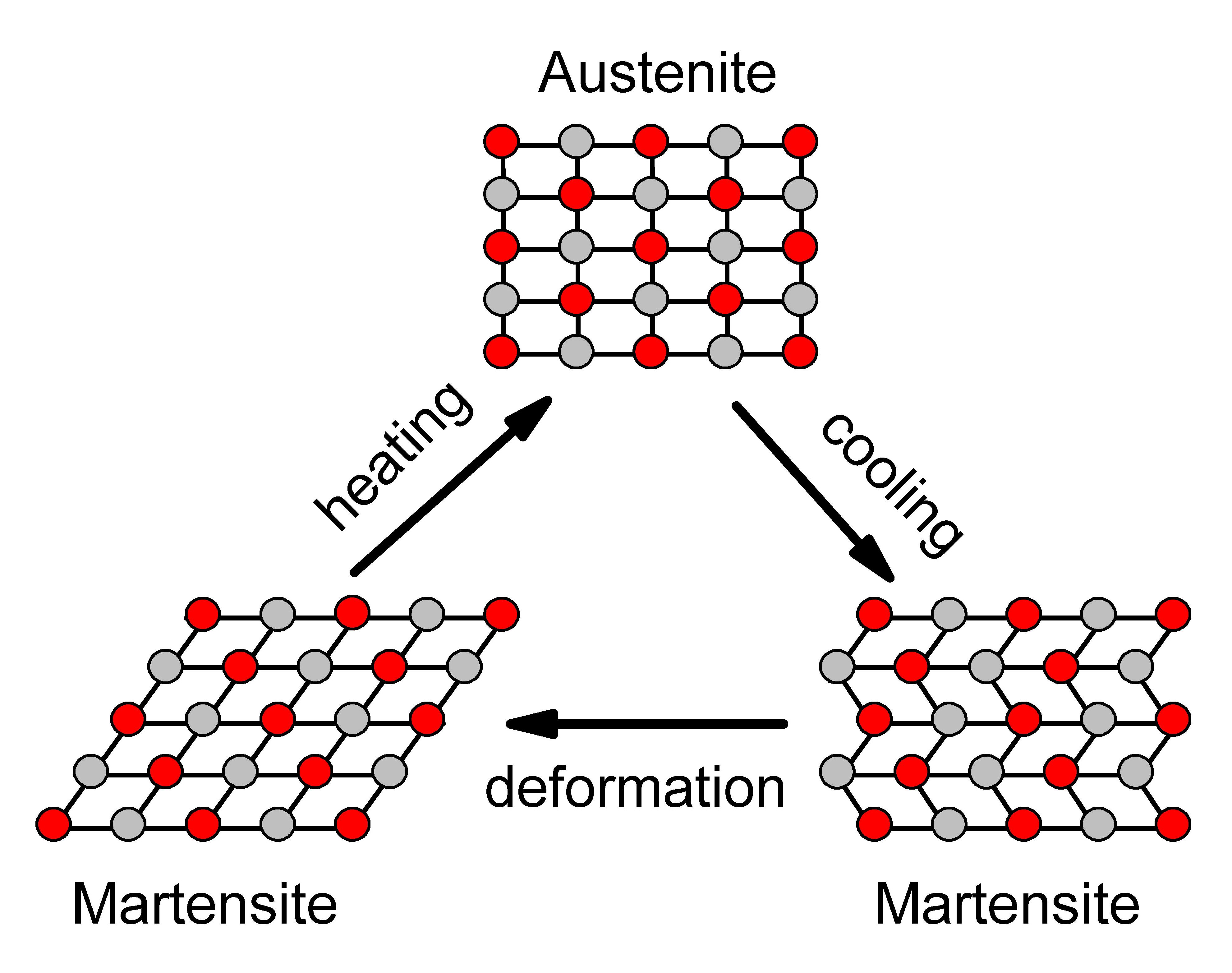
Nitinol (a nickel-titanium alloy) has three main phases: Twinned Martensite, De-twinned Martensite, and Austenite. The image below shows these atomic phases during heating and cooling. De-twinning doesn't change the alloy's mechanical properties; it changes only how the atoms align, which stores energy.

<figure><img src="https://1078621213-files.gitbook.io/~/files/v0/b/gitbook-x-prod.appspot.com/o/spaces%2Fm2yg571oTEEeXffjpREo%2Fuploads%2Fgit-blob-bdb7cdf8d46ca627f37c7a6783dc0fe61b8b112f%2FNiTi_structure_transformation.jpg?alt=media" alt="" width="563"><figcaption><p>De-twinned Martensite (left), Twinned Martensite (right), Austenite (top)</p></figcaption></figure>

### Transitions as an actuator

As Nitinol moves between phases, it behaves as an actuator. Three transitions matter:

* **Contraction:** When heated, the actuator shortens and the Nitinol transitions from the De-twinned Martensite phase to the Austenite phase.
* **Cooling cycle:** When power is off and the muscle is left to dissipate heat, the Nitinol transitions from the Austenite phase to the Twinned Martensite phase.
* **Under load:** While the actuator is under stress and being deformed (for example, being stretched out by a water jug or pulled), the Nitinol transitions from the Twinned to the De-twinned Martensite phase.

### Phase structure

Nitinol exhibits different crystal lattice structures depending on its phase:

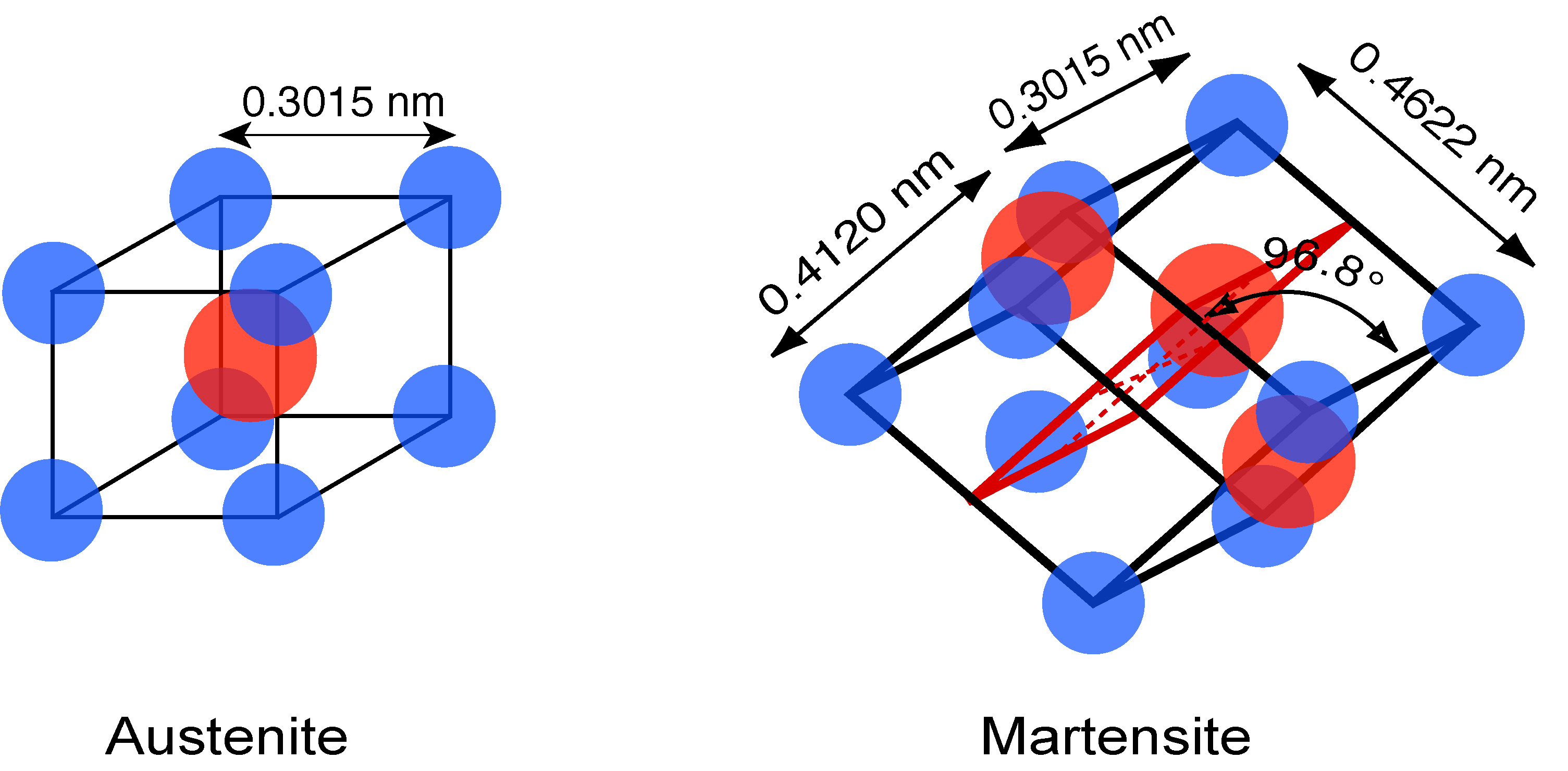
<table data-card-size="large" data-view="cards" data-full-width="true"><thead><tr><th></th><th></th><th data-hidden data-card-cover data-type="files"></th></tr></thead><tbody><tr><td><strong>Austenite Phase</strong></td><td>In the high-temperature phase, Nitinol has a B2 cubic structure. This is a body-centered cubic (BCC) lattice where nickel and titanium atoms are positioned at the corners and the center of the unit cell. This phase is much more dense than the Martensite phase because of its cubic structure.</td><td></td></tr><tr><td><strong>Martensite Phase(s)</strong></td><td>In the low-temperature phases, Nitinol transforms into Martensite, which has a less dense, elongated, structure. This phase can have different forms depending on the specific alloy composition and thermal treatment. The most common form is the Monoclinic B19' Structure; it has a distorted lattice, allowing for significant deformation and the shape memory effect.</td><td></td></tr></tbody></table>

<figure><img src="https://1078621213-files.gitbook.io/~/files/v0/b/gitbook-x-prod.appspot.com/o/spaces%2Fm2yg571oTEEeXffjpREo%2Fuploads%2Fgit-blob-a2d1a29112e803285b99d8c196a6b90247842228%2FNitinol_Austenite_and_martensite.jpg?alt=media" alt="" width="563"><figcaption><p>Lattice comparison between the Austenite and Martensite phases of Nitinol.</p></figcaption></figure>

### Temperature data

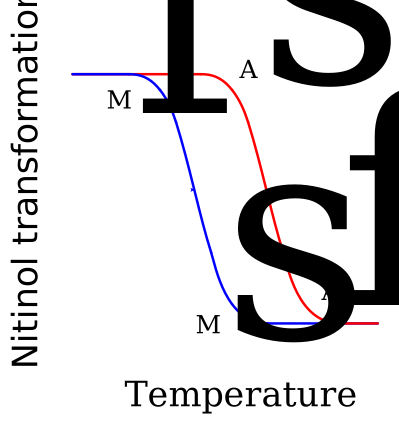
Nitinol has a hysteretic curve for temperature vs strain/transformation. Below is an image of this curve with Austenite start (As), Austenite finish (Af), Martensite start (Ms), and Martensite finish (Mf) phases listed.

<figure><img src="https://1078621213-files.gitbook.io/~/files/v0/b/gitbook-x-prod.appspot.com/o/spaces%2Fm2yg571oTEEeXffjpREo%2Fuploads%2Fgit-blob-4d840482a4746ee69f7279973a730380d8ae180f%2FNitinol_transformation_hysterisis.svg?alt=media" alt=""><figcaption></figcaption></figure>

### Alloy ratios

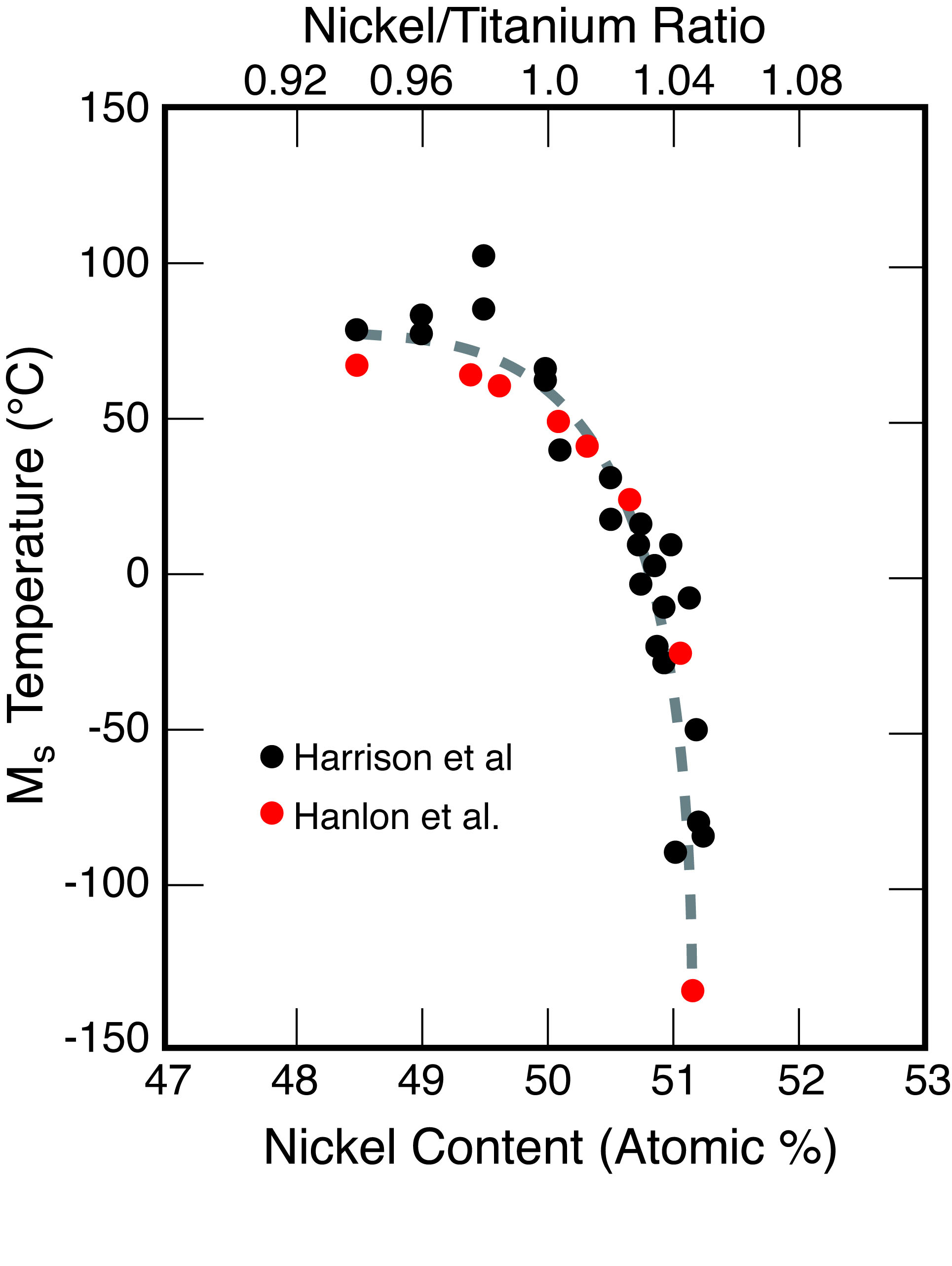
Nitinol's activation temperature, otherwise known as Austenite finish (Af), changes based on the ratio of Nickel to Titanium. A greater Nickel percentage in the alloy's composition lowers the activation temperature.

{% hint style="info" %}
**Delta's alloy:** Delta uses a Nitinol alloy with a 90 °C activation temperature.
{% endhint %}

<figure><img src="https://1078621213-files.gitbook.io/~/files/v0/b/gitbook-x-prod.appspot.com/o/spaces%2Fm2yg571oTEEeXffjpREo%2Fuploads%2Fgit-blob-5a911ae892478cac6764f1ba9f789e8d8091c30b%2FNitinol_Ms_vs_Ni_content.jpg?alt=media" alt="" width="563"><figcaption></figcaption></figure>

## Material properties

The tables below outline the [generalized properties](https://en.wikipedia.org/wiki/Nickel_titanium) of Nitinol alloy in its different phases. Click the links for more information about any of the specific properties mentioned.

{% tabs %}
{% tab title="Austenite" %}

| Material properties                                                                             | Value                       |
| ----------------------------------------------------------------------------------------------- | --------------------------- |
| [Melting point](https://en.wikipedia.org/wiki/Melting_point)                                    | 1,310 °C (2,390 °F)         |
| [Density](https://en.wikipedia.org/wiki/Density)                                                | 6.45 g/cm3 (0.233 lb/cu in) |
| [Electrical resistivity](https://en.wikipedia.org/wiki/Electrical_resistivity_and_conductivity) | 82×10−6 Ω·cm                |
| [Thermal conductivity](https://en.wikipedia.org/wiki/Thermal_conductivity)                      | 0.18 W/cm·K                 |
| [Coefficient of thermal expansion](https://en.wikipedia.org/wiki/Thermal_expansion)             | 11×10−6/°C                  |
| [Magnetic permeability](https://en.wikipedia.org/wiki/Magnetic_permeability)                    | < 1.002                     |
| [Magnetic susceptibility](https://en.wikipedia.org/wiki/Magnetic_susceptibility)                | 3.7×10⁻⁶ emu/g              |
| [Elastic modulus](https://en.wikipedia.org/wiki/Elastic_modulus)                                | 75–83 GPa                   |
| [Yield strength](https://en.wikipedia.org/wiki/Yield_strength)                                  | 195–690 MPa                 |
| [Poisson's ratio](https://en.wikipedia.org/wiki/Poisson's_ratio)                                | 0.33                        |
| {% endtab %}                                                                                    |                             |

{% tab title="Martensite" %}
These values are applicable to both the Twinned and De-twinned states.

| Material properties                                                                             | Value                       |
| ----------------------------------------------------------------------------------------------- | --------------------------- |
| [Melting point](https://en.wikipedia.org/wiki/Melting_point)                                    | 1,310 °C (2,390 °F)         |
| [Density](https://en.wikipedia.org/wiki/Density)                                                | 6.45 g/cm3 (0.233 lb/cu in) |
| [Electrical resistivity](https://en.wikipedia.org/wiki/Electrical_resistivity_and_conductivity) | 76×10−6 Ω·cm                |
| [Thermal conductivity](https://en.wikipedia.org/wiki/Thermal_conductivity)                      | 0.086 W/cm·K                |
| [Coefficient of thermal expansion](https://en.wikipedia.org/wiki/Thermal_expansion)             | 6.6×10⁻⁶/°C                 |
| [Magnetic permeability](https://en.wikipedia.org/wiki/Magnetic_permeability)                    | < 1.002                     |
| [Magnetic susceptibility](https://en.wikipedia.org/wiki/Magnetic_susceptibility)                | 2.4×10⁻⁶ emu/g              |
| [Elastic modulus](https://en.wikipedia.org/wiki/Elastic_modulus)                                | 28–40 GPa                   |
| [Yield strength](https://en.wikipedia.org/wiki/Yield_strength)                                  | 70–140 MPa                  |
| [Poisson's ratio](https://en.wikipedia.org/wiki/Poisson's_ratio)                                | 0.33                        |
| {% endtab %}                                                                                    |                             |
| {% endtabs %}                                                                                   |                             |

## Related pages

* [How to Train Nitinol](/docs/learn/how-to-train-nitinol.md): Shape-set your own wire using the phases described here.
* [Further Research](/docs/learn/further-research.md): Curated papers, guides, and data sheets to go deeper.
* [Learn](/docs/learn.md): The rest of the Nitinol knowledge base.

For other questions, contact us and we'll point you toward the right material for your application.