> For the complete documentation index, see [llms.txt](https://delta-robotics.gitbook.io/docs/llms.txt). Markdown versions of documentation pages are available by appending `.md` to page URLs; this page is available as [Markdown](https://delta-robotics.gitbook.io/docs/hardware/aeroflex.md).

# AeroFlex™ (In Development)

AeroFlex is an open standard for braided pneumatic artificial muscles, with a reference muscle you can build for about $10 and the docs and tools behind it

{% hint style="info" %}
AeroFlex is an open standard under active development and pre-1.0. The reference muscle is buildable today, but geometry, interfaces, and performance numbers will change until a 1.0 release. Nothing is stable yet.
{% endhint %}

Pneumatic artificial muscles are not new. Classic McKibben-style muscles have been in labs since the 1950s: light, strong, compliant, and cheap to make. They never went mainstream because every muscle is a one-off, with undocumented geometry, unknown force curves, and no standard way to connect one to anything.

AeroFlex fixes the boring part. It is an open standard for braided pneumatic muscles that specifies the muscle and its connection interfaces the way a servo's spline, plug, and signal are specified, so muscles and the parts that drive them work together no matter who built them.

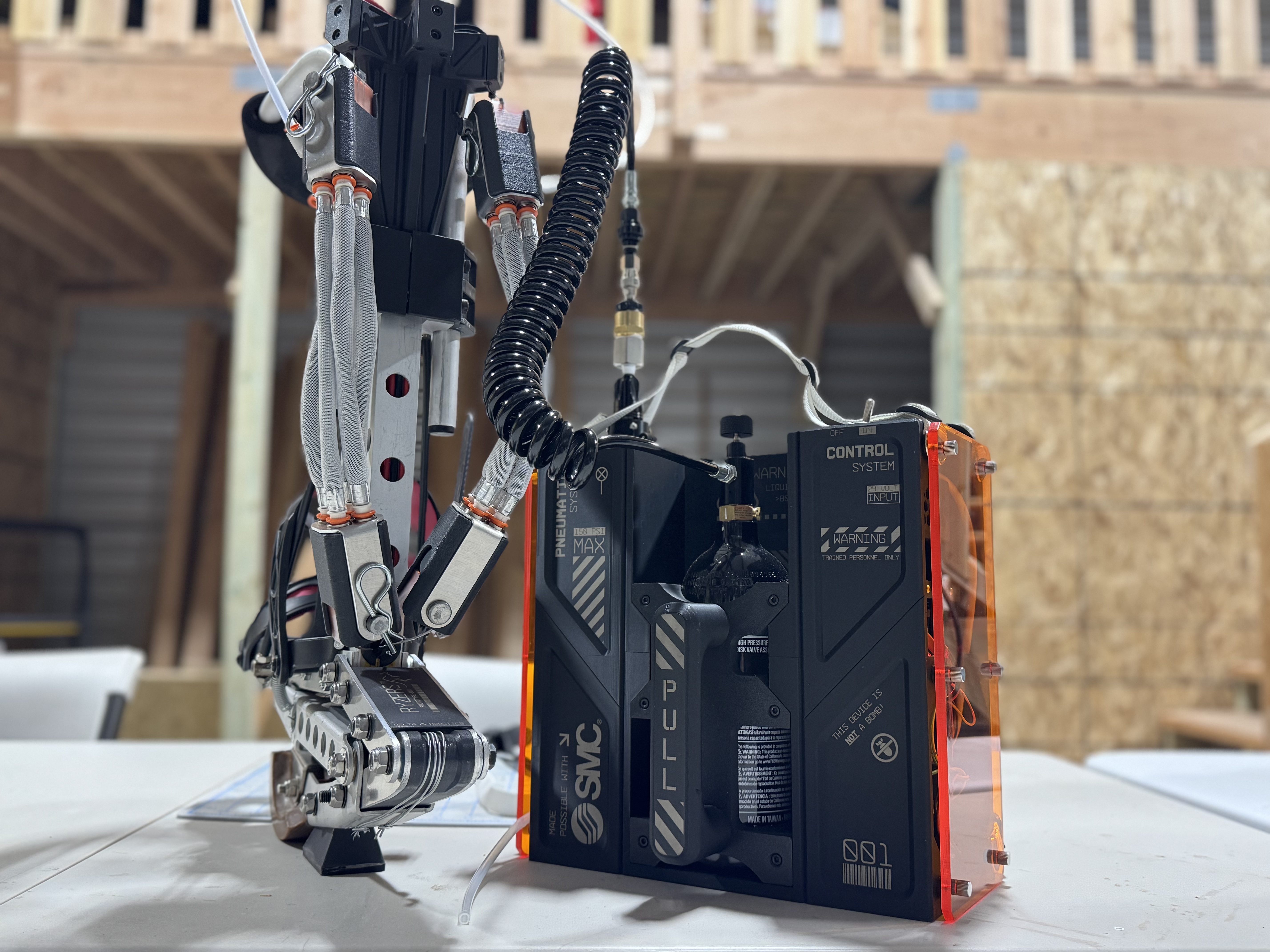
<div data-full-width="false"><figure><img src="https://1078621213-files.gitbook.io/~/files/v0/b/gitbook-x-prod.appspot.com/o/spaces%2Fm2yg571oTEEeXffjpREo%2Fuploads%2Fgit-blob-478374b36a2712a3875a5ace2cb49210b3d77df6%2FRyzers%20Glam%20Shot.JPEG?alt=media" alt="A lower-body exoskeleton frame driven by braided pneumatic muscles"><figcaption><p>A lower-body exoskeleton driven by a prototype AeroFlex pneumatic muscle system.</p></figcaption></figure></div>

## What is a pneumatic artificial muscle?

A braided pneumatic muscle is a soft inner tube inside a braided sleeve, connected to compressed gas. Pump gas in and the tube pushes outward against the braid. The braid trades that swelling for length: the muscle gets fatter and shorter, and pulls hard along its axis. Think of a Chinese finger trap in reverse. This McKibben geometry is well understood; AeroFlex standardizes, instruments, and packages it so it is practical to build with.

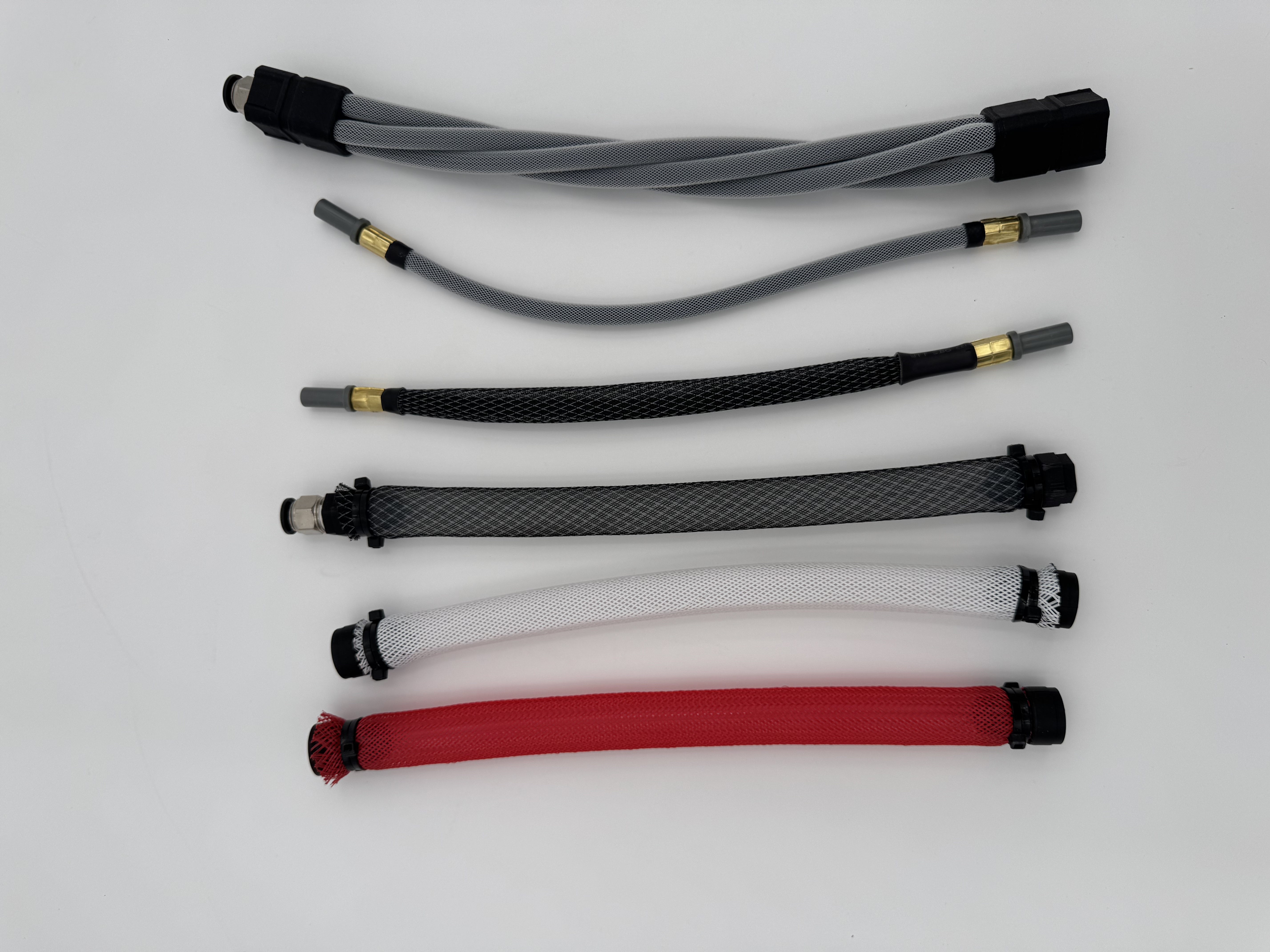
<figure><img src="https://1078621213-files.gitbook.io/~/files/v0/b/gitbook-x-prod.appspot.com/o/spaces%2Fm2yg571oTEEeXffjpREo%2Fuploads%2Fgit-blob-57dce85439d3c7cfb663bb9a7e5572ea412231c9%2FIMG_3342.JPEG?alt=media" alt="A set of early braided pneumatic muscle prototypes"><figcaption><p>Early AeroFlex prototypes.</p></figcaption></figure>

## Why pneumatic muscles are interesting

### High power-to-weight

For their size and mass, braided muscles pull hard and move fast, so they fit joints and linkages where a motor and gearbox will not.

### Inherently compliant

Muscles are soft by default. That means safer contact with people and less damage in a collision, without faking compliance in software.

### Quiet operation

Most of the noise comes from the compressor, not the muscle. Park the compressor off-board or run short bursts from a buffer tank, and the moving part stays quiet.

### Simple to build

A basic muscle is soft tubing, a braided sleeve, and end fittings. No machine shop required, which suits labs, classrooms, and garage projects.

### Decoupled power

The heavy parts, the compressor, tank, and regulator, can live off-joint, with light air lines running to the muscle. That matters for wearables and mobile robots.

## AeroFlex is an open standard

Build against the standard and a muscle from one maker fits hardware from another. Documented geometry, repeatable performance, and shared connection interfaces are what turn an actuator into a part you can specify, order, and swap. Motors and cylinders got that decades ago. Soft actuators never did, and that is a large part of why engineers keep reaching past them: with no standard test protocols and no supply chain, you cannot compare two muscles or certify either one.

Delta Robotics ships its own AeroFlex product line, and anyone else can build muscles, controllers, and kits for the same ecosystem. The standard is Apache-2.0 and free to implement. The rules around the name itself are in [Ecosystem and trademark](#ecosystem-and-trademark), further down this page.

## Build your first muscle

The reference muscle is hand-assembled from about $10 of off-the-shelf parts in under an hour: latex tubing, a PET overexpanded braided sleeve, adhesive-lined heat shrink, two stem-barb connectors, and crimp ferrules. Materials for a 12 inch muscle come to roughly $4; shipping spread across a small order is what brings the landed cost near $10. Drive it with regulated air or CO2 at 30 to 100 psi. Current builds target 20 to 35 percent stroke, with about 50 percent as the design goal.

The sequence is short. Cut the tube and sleeve, slide the tube inside the braid, shrink an adhesive-lined band over each end, seat a barb with isopropyl alcohol, crimp a ferrule over the stack, then leak-test. Those heat-shrink bands carry more weight than their size suggests: they pull braid and latex tight together and cushion the crimp at the end fittings, which is where most muscles fail. Three one-time tools cover every build after the first: a hydraulic crimper, a variable-temperature heat gun, and a hot knife for cutting PET without fraying it.

<figure><img src="https://1078621213-files.gitbook.io/~/files/v0/b/gitbook-x-prod.appspot.com/o/spaces%2Fm2yg571oTEEeXffjpREo%2Fuploads%2Fgit-blob-7fd853da54e2b03cfb0844a23224740fce5b490f%2Faeroflex-muscle-prototype.jpg?alt=media" alt="A hand-held 3D-printed manifold block with two braided pneumatic muscles plugged into its push-to-connect ports"><figcaption><p>A printed manifold block with two AeroFlex muscles plugged into its push-to-connect ports.</p></figcaption></figure>

{% hint style="warning" %}
Compressed gas stores real energy. Read the validation and safety notes in the repository before you pressurize anything.
{% endhint %}

<a href="https://github.com/Delta-Robotics-Inc/AeroFlex" class="button primary" data-icon="github">AeroFlex on GitHub</a>

## What is in the standard

The standard is a public repository under Apache-2.0. Each document below covers one part of turning a pneumatic muscle into something you can specify rather than reinvent.

| Document                                                                                                               | What it gives you                                                                                                                             |
| ---------------------------------------------------------------------------------------------------------------------- | --------------------------------------------------------------------------------------------------------------------------------------------- |
| [Reference muscle design](https://github.com/Delta-Robotics-Inc/AeroFlex/blob/main/docs/design.md)                     | Materials, geometry, end-fitting choices, performance characteristics, honest limitations, and the validation plan the numbers will come from |
| [Theory](https://github.com/Delta-Robotics-Inc/AeroFlex/blob/main/docs/theory.md)                                      | The force-pressure equation with a worked example, what sets stroke, and the reference values behind both                                     |
| [Components and sourcing](https://github.com/Delta-Robotics-Inc/AeroFlex/blob/main/docs/components.md)                 | The wider parts notebook: tubing, sleeve, heat shrink, fittings, thread standards, regulators, valves, CO2 supply, and sensors                |
| [Background](https://github.com/Delta-Robotics-Inc/AeroFlex/blob/main/docs/background.md)                              | Why artificial muscles stalled, covering performance, cost, missing standards, and the incumbent motors and cylinders                         |
| [Muscle BOM](https://github.com/Delta-Robotics-Inc/AeroFlex/blob/main/manufacturing/muscle-bom.md)                     | Every part to buy with verified prices, cost by muscle length, batch math, sourcing notes, and the one-time tools                             |
| [Assembly sequence](https://github.com/Delta-Robotics-Inc/AeroFlex/blob/main/manufacturing/muscle-assembly.md)         | The validated hand build, step by step, and why the heat-shrink step exists                                                                   |
| [Airtight 3D printing](https://github.com/Delta-Robotics-Inc/AeroFlex/blob/main/manufacturing/airtight-3d-printing.md) | How to print manifolds and connector blocks that hold pressure, with print settings, finishing methods, and a three-tier leak test            |
| [Telemetry HUD](https://github.com/Delta-Robotics-Inc/AeroFlex/blob/main/apps/hud/README.md)                           | A single-file browser dashboard for muscle controllers, plus the serial protocol it reads                                                     |
| [Research library](https://github.com/Delta-Robotics-Inc/AeroFlex/blob/main/research/README.md)                        | Cited literature on muscle modeling, sensing, fabrication, multi-filament architectures, and commercial benchmarks                            |
| [Datasheet index](https://github.com/Delta-Robotics-Inc/AeroFlex/blob/main/datasheets/README.md)                       | Vendor spec sheets and design guides, each linked back to its original public source                                                          |

The research and datasheet pages are indexes, not file dumps. Publishers and vendors own most of those PDFs, so each entry links to the DOI, the open-access copy, or the vendor's own download instead.

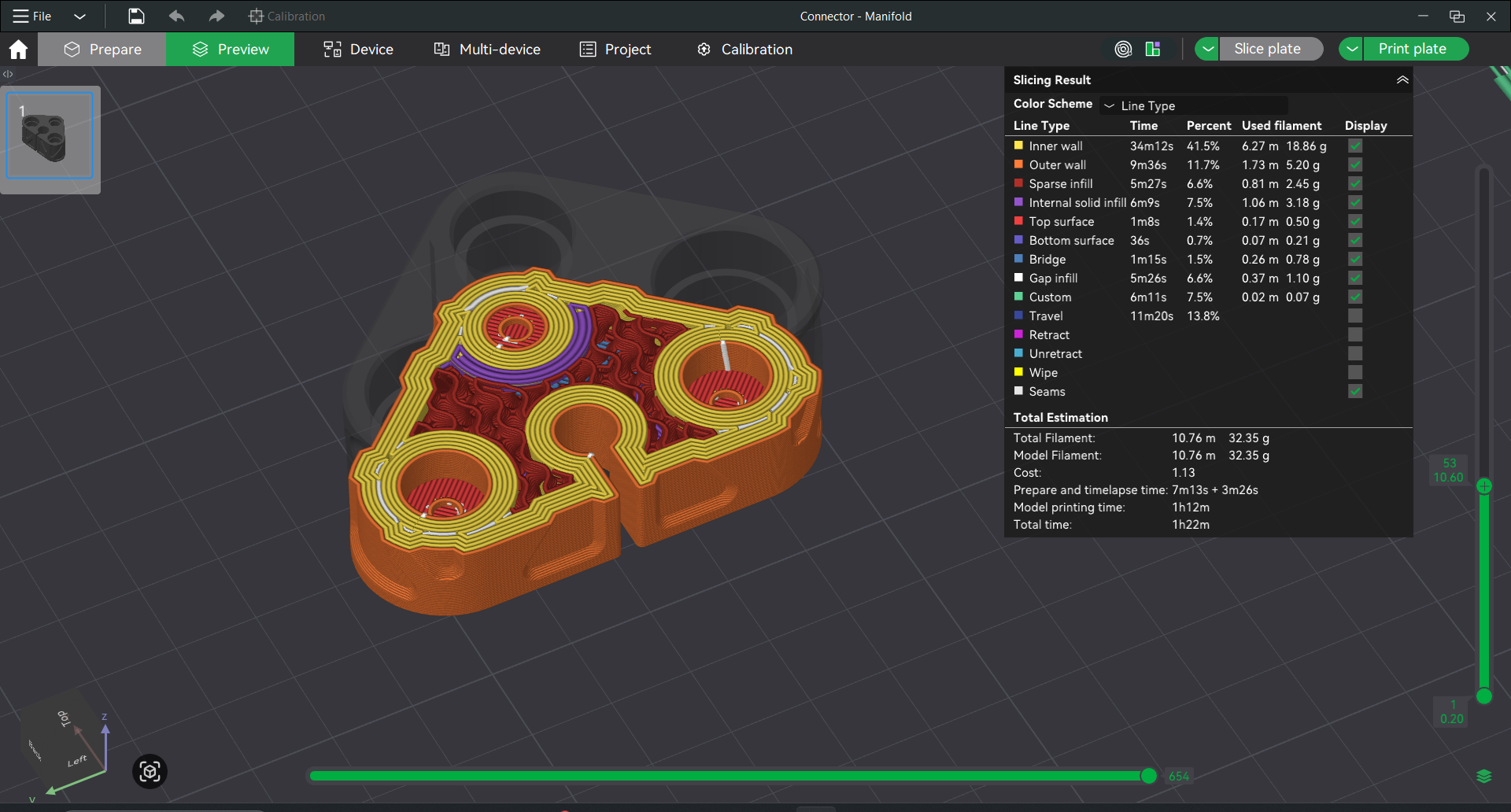
<figure><img src="https://1078621213-files.gitbook.io/~/files/v0/b/gitbook-x-prod.appspot.com/o/spaces%2Fm2yg571oTEEeXffjpREo%2Fuploads%2Fgit-blob-f3c663423df6887ea0365d905eae6a5bbe34ccf6%2Faeroflex-printed-internal-view.png?alt=media" alt="Sliced cross-section of a 3D-printed pneumatic connector block showing wall loops and infill"><figcaption><p>Inside a printed connector block. The airtight printing guide covers how wall loops and infill are tuned to hold pressure.</p></figcaption></figure>

### The browser telemetry HUD

The HUD is one HTML file. Open it in Chrome or Edge, click Connect, pick your controller's serial port, and muscle pressure, supply pressure, battery, valve state, and faults land on live gauges with a 60 second trend graph. Nothing to install, no drivers, no build step. Web Serial is the one hard requirement, so Firefox and Safari are out. A Demo button simulates a full controller if you have no hardware in front of you yet.

The HUD does not care what your controller is. An Arduino Uno R4 Minima, a Nano, an ESP32, or a Pi Pico all work, as long as the board prints one telemetry line at a time at 115200 baud. Only the state tag is required. Every other token is optional, and missing channels show as dashes rather than breaking the page. Any extra `name=value` token you print gets captured automatically and can be wired to a new gauge with one line of config. Commands go back the other way as single characters for target up and down, fill, vent, and e-stop.

One limit worth stating plainly: the HUD is a monitor and a remote, not a safety system. Pressure caps, vent-on-fault behavior, and lockouts belong in controller firmware.

## The road to 1.0

Nothing in the standard is stable until 1.0, and changes land in the repository changelog as they happen. Two documents stand between here and that release:

* A formal interface specification covering mounting, pneumatic connections, and sensing.
* A conformance checklist, so "AeroFlex compatible" becomes a claim you can check instead of assert.

### Performance data on the way

The docs describe a muscle you can build. What they cannot tell you yet is what it will pull at a given pressure and length. Three things close that gap:

* Force, pressure, and stroke curves for reference builds, published as data alongside the docs.
* The test rigs and procedures used to characterize muscles, documented so your numbers and ours are comparable.
* Cycle life, leak rates, hysteresis, and response times from real builds, logged as they accumulate.

### What we are researching

* Longer stroke, toward the 50 percent design goal, using low-angle braids and multi-filament bundles
* Smaller pneumatics sized for wearable flow and pressure instead of industrial rigs
* Integrated pressure, force, and length sensing so muscles behave like real actuators
* Tubing, braid, and end fittings that survive repeated cycling, with published cycle life and failure modes

<figure><img src="https://1078621213-files.gitbook.io/~/files/v0/b/gitbook-x-prod.appspot.com/o/spaces%2Fm2yg571oTEEeXffjpREo%2Fuploads%2Fgit-blob-b99911edb81efd676ae6f4fec27c832beed1646a%2Faeroflex-build-iterations.jpg?alt=media" alt="Three iterations of AeroFlex pneumatic hardware, a printed regulator mount, a blue anodized inline regulator, and a printed connector block"><figcaption><p>Hardware iterates alongside the docs. A printed regulator mount with a retaining clip and push-to-connect elbow, a blue anodized inline regulator with crimped ferrule ends, and a compact printed connector block.</p></figcaption></figure>

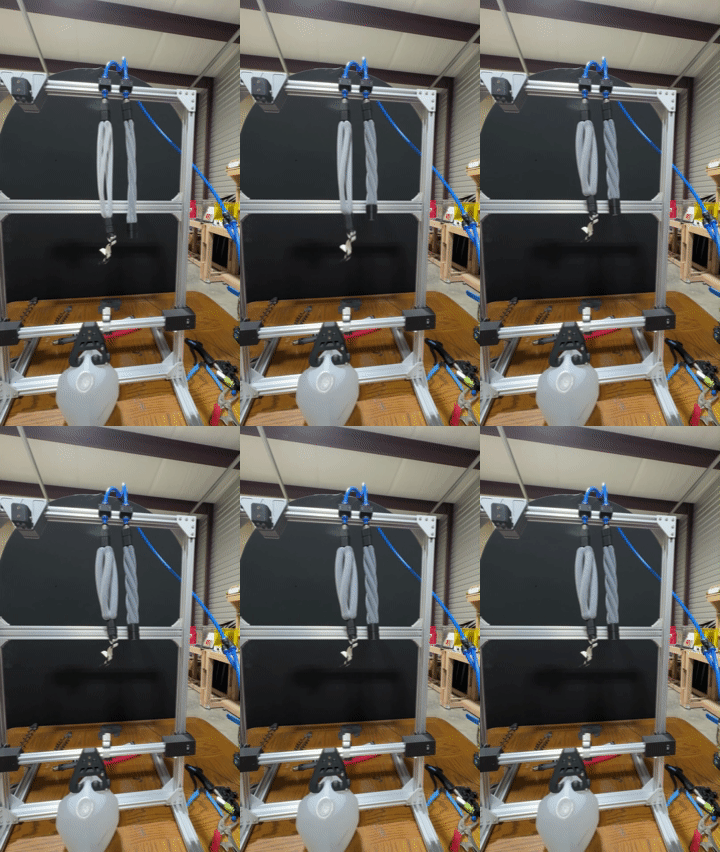
<div align="center" data-full-width="false"><figure><img src="https://1078621213-files.gitbook.io/~/files/v0/b/gitbook-x-prod.appspot.com/o/spaces%2Fm2yg571oTEEeXffjpREo%2Fuploads%2Fgit-blob-6728e84d9ddfdf323d4255ecf6588defdd74b5d9%2FMuscle%20Test.gif?alt=media" alt="A braided pneumatic muscle contracting on a test bench"><figcaption><p>Testing multi-filament designs.</p></figcaption></figure></div>

## Ecosystem and trademark

You do not need permission to implement AeroFlex. Build muscles, controllers, kits, or whole machines against it, sell them, and say they work with the AeroFlex Standard. Apache-2.0 covers everything in the repository and grants patent rights with it. Delta Robotics ships an AeroFlex product line on exactly those terms, the same ones available to everyone else.

The name is the one exception. "AeroFlex" is a Delta Robotics trademark, and Apache-2.0 does not grant trademark rights. Descriptive compatibility statements are free: "compatible with the AeroFlex Standard", "works with AeroFlex muscles", or "built for the AeroFlex ecosystem" need no approval, and neither does using the name in articles, papers, videos, and tutorials. Ask first before putting AeroFlex in a product, company, or domain name, or before using the logo on packaging and marketing. Never rebrand a modified copy of the standard as AeroFlex; fork it under your own name and note what it derives from. The full rules are short, and they live in the repository's [trademark policy](https://github.com/Delta-Robotics-Inc/AeroFlex/blob/main/TRADEMARKS.md).

A lightweight "AeroFlex Compatible" program with basic conformance checks is planned. Until it ships, descriptive statements are how you signal compatibility.

## Related pages

* [HydraFlex™ (In Development)](/docs/hardware/hydraflex.md): The hydraulic sibling, aimed at higher force density.
* [Hardware](/docs/hardware.md): The rest of the Delta hardware line.
* [Safety essentials](/docs/get-started/safety.md): Delta's consolidated hazard list, which applies to pressurized builds too.
* [AeroFlex on GitHub](https://github.com/Delta-Robotics-Inc/AeroFlex): The full standard, BOM, and assembly guide.